OPEN VOICINGS - Basic Formulas
The formulas work well
for all the basic chord types: Maj7, Dom7, Min7, Maj6, Min6, Min7b5, Min-Maj7,
Aug7, Dim7,
Substitute 6 for 7 in the formulas for Maj6 and Min6 chords.
The
italicized number is the melody note or note being harmonized.
Practice all nine chord types with all 4 formulas in 12 keys.
That's
9 x 4 x 12 or 432 chords. It's a big job and will require weeks if not months
of practice.
Practice the chords through the cycle of fifths, diatonically,
chromatically and using random drill sheets.
| | | | | |
| Left
Hand | | Right
Hand | |
| 1-7 | | 3-5-1 |
The root (1) is the top note, the melody note being harmonized |
| 1-5 | | 3-7-3 | The
third is the melody |
| 1-5 | | 7-3-5 | The
fifth is the melody |
| 1-5 | | 7-3-7 | The
seventh is the melody |
| | | | |
HOW
TO USE THE OPEN VOICING FORMULAS
Lead sheets only give you the
melody and the harmony (chord symbols). Beginners often start by playing the melody
with the right hand
and the chords with their left. Open voicings allow the
chord to be played by sharing the notes of the chord with both hands. The result
is
better sounding chords and more flexibility to add/alter tones to provide
a richer harmonic palette. To use the formulas,
1. Select the melody notes
to be harmonized. Typically these are notes on strong beats like beat 1 and beat
3 in 4/4 time.
2. Determine quickly if the melody note is part of the chord
(root(1), 3rd, 5th, 7th), or a non-chord tone. If the note is part of the chord,
you're in luck! Play the note as written with the appropriate
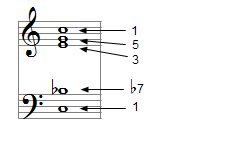
formula filling in the chord underneath. In Fig. 1, the melody note is C and the
chord is C7. Use the 1st formula since the melody is the 1 (root)
Examples:
1
The melody note is C and the chord is C7.
Use the first formula since the melody
is the 1.
See Fig.1 |
Fig.
1
 | |
2.Bb
major seventh chord with the 3rd (D) on top.
Use the second formula. Bbmaj7
would be played:
Left hand: Bb-A (1-7) and Right hand D-A-D (3-7-3)
| | |
3.
Maj6 chord wth 5th on top.
Use the 3rd formula. Eb6 would be played Left hand
Eb-Bb (1-5) and Right hand C-G-Bb (6-3-5)
| | |
| | | |
Be
sure that no interval except Left Hand 1-7 exceeds a 6th. In other words, don't
have your hand far apart from each other
on the keyboard creating a chord
with a large interval between the hands.
4. Sometimes the melody note (top
note) results in the open voicing being too low on the keyboard.
When chords
are placed too low on the keyboard, the chord is muddy and bad sounding. The Open
Voicing formula
can be changed to make the chord smaller so that it is placed
in a more acceptable range.
Example:
A song calls for a Ab7 chord and
the melody note is middle C. Following the formula gives an acceptable chord but
to some pianists,
the chord will not have a pleasing sound. The chord can be
made smaller by eliminating the doubled note and moving the left hand up an octave.
Left
hand: Ab-Eb (1-5) up an octave, and Right Hand: Gb-C (7-3) not 3-7-3.
| 4. |
Many times, the melody note will not be a chord tone and can be dealt with several
ways. | |
| |
A.
Find a chord formula where the top note is close to the melody note. Using the
formula adjust the top note to make it the melody note. Example: Melody note is
D and chord is Am7. Since the melody note D is near the chord tone C (3rd of the
chord Am7), select the 2nd formula and adjust the top note to D.
Left hand
A-E (1-5); -------- Right hand C-G-D. (3-7- melody note) | 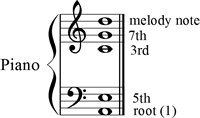 |
| |
B.
If the melody note is a tension (and it usually is), refer to the formulas
for tensions. | |
| |
C.
Construct your own voicing. | |